
Google Ads for Physiotherapists
Timely Visibility for Physio Clinics When Patients Are Actively Searching for Care
AHPRA-aware Google Ads management designed to help physiotherapy clinics appear at the right time, in the right locations, and for the right services, while supporting a broader Local Growth System.

AHPRA-Aware Marketing

Proven Local Growth Strategies

AI-Enhanced Systems

Australian-based strategists

Google reviews 5 stars
If Google Ads Have Felt Inconsistent or Costly, You’re Not Alone
Many physiotherapists rely on referrals and word-of-mouth to grow. When demand fluctuates or competition increases, Google Ads are often suggested as a solution, but without clear explanation.
You may have experienced:
- Ads generating enquiries that were not a good fit
- High spend during busy periods with limited return
- Confusion around keywords, budgets, or reporting
- Campaigns optimised for clicks rather than bookings
Google Ads can support growth for physio clinics, but only when they are structured around patient intent and realistic expectations.

What Google Ads Actually Do for Physiotherapy Clinics
Google Ads allow your clinic to appear when someone is actively searching for physiotherapy services in your area.
For physio clinics, Ads can help:
- Capture high-intent searches for pain, injury, or mobility support
- Support faster enquiries during growth or seasonal peaks
- Compete in competitive local markets
- Maintain enquiry flow while SEO builds longer-term visibility
Unlike SEO, Ads do not compound over time. Visibility stops when spend stops, which is why Ads are most effective when used as part of a broader strategy.
Google Ads vs SEO:
Different Roles, Same Goal
Google Ads and SEO are often compared, but they serve different purposes.
SEO supports long-term, compounding visibility and trust.
Google Ads support faster visibility when timing matters.
Neither replaces the other.
For many physiotherapy clinics, Ads act as a bridge, providing enquiries while SEO and local SEO establish sustainable growth underneath.
Google Ads vs Local SEO:
Visibility vs Proximity
Local SEO helps your clinic appear in Google Maps when patients search nearby.
Google Ads allow your clinic to appear above organic results for high-intent searches, even in competitive suburbs.
When used together:
– Local SEO supports trust and familiarity
– Google Ads capture immediate intent
This combination is particularly effective for clinics treating acute injuries or time-sensitive conditions.
Google Ads in an AI-Led Search Environment
Search behaviour continues to evolve, but paid search remains a core visibility channel.
AI-assisted search still:
- Surfaces paid results for high-intent queries
- Rewards relevance, clarity, and landing page quality
- Relies on strong website structure and accurate messaging
For physiotherapy clinics, Ads remain effective when aligned with patient intent and supported by strong foundations.

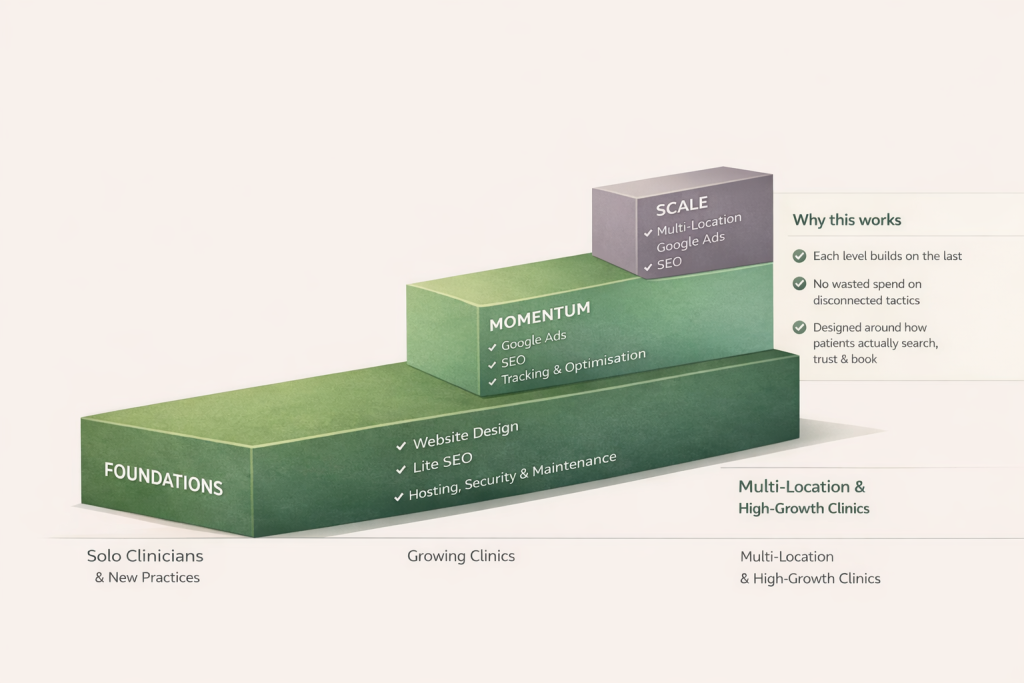
Google Ads as Part of the Local Growth System
Google Ads perform best when they are not run in isolation.
Within the Local Growth System, Ads align with:
- Website structure and service pages
- SEO and local SEO signals
- Conversion tracking and call attribution
- Ongoing optimisation and refinement
This ensures Ads support meaningful enquiries rather than wasted spend.
How Google Ads Are Approached for Physiotherapists
Google Ads for physio clinics require a careful balance between visibility, intent, and ethical communication.
Our approach focuses on:
- Identifying which physio services are suitable for Ads
- Structuring campaigns around treatment intent rather than volume
- Aligning ads with clear, patient-first landing pages
- Tracking calls and online enquiries accurately
- Reviewing and refining campaigns over time
All Ads activity is developed with awareness of healthcare advertising guidelines and platform policies. No guarantees are made, and outcomes vary based on competition and market conditions.
Are Google Ads Right for Your Physiotherapy Clinic?
Google Ads are often suitable for:
Ads may not be the right choice for every clinic or at every stage. Suitability is assessed as part of strategy, not assumed.